Real People in AI Video: Likeness, Voice and Platform Rules
AI video that uses a real person's face or voice needs their permission. Japan's 2026 guidance, ad platform rules, AI tool terms, and what consent covers.
If you make a video that uses a real person's face or voice through generative AI, or a video made to resemble a real person, you need that person's permission first. Labeling the video "made with AI" does not make use without permission acceptable.
On August 7, 2026, Japan's Ministry of Justice published a report setting out interpretive guidance on infringement of the right of publicity and related issues involving generative AI. Its summary states that the "likeness, etc." protected under Japanese law includes a person's voice, and that using it in advertising is a typical form of infringement. This article sorts out, for both the companies commissioning videos and the people making them, what we could confirm on the official pages of Japanese government agencies, ad platforms and AI services as of October 14, 2026. If you need a judgment on a specific case, consult a lawyer or another expert.
Japan's Ministry of Justice guidance: voice is covered as well as likeness
Under Japanese law, the right of publicity protects the power of a person's likeness and similar attributes to drive sales of products (their "customer-attracting power"). In a 2012 judgment, Japan's Supreme Court named three typical cases in which unauthorized use is unlawful. The Ministry of Justice summary applies these to generative AI as follows.
- 01Selling the likeness itself as something to be viewed and enjoyed (posters, photo books, etc.)
- 02Attaching the likeness to products to set them apart (T-shirts, mugs, etc.)
- 03Using the likeness as advertising (TV and web ads, impersonation ads on social media). For voice, use in advertising narration is given as an example
A face or voice made with generative AI is never completely identical to the real person's. The summary says that whether it can be considered that person's is judged by the degree of resemblance together with other information that suggests the person, such as clothing or a displayed name. It says impersonations of a person's look or voice do not, as a rule, infringe the right, but there may be room for infringement when viewers mistake the impersonation for the real person.
Under Japan's Unfair Competition Prevention Act, the summary notes that using a famous person's likeness without permission may fall under the act even with a disclaimer such as "not affiliated with this person." It also states that using the likeness or voice of a deceased person may hurt the feelings of the bereaved family.
Sources
- Ministry of Justice: Publication of the report of the study group on civil liability for unauthorized use of likeness, voice, etc. (August 7, 2026) (in Japanese)
- Same, report (PDF) (in Japanese)
- Same, summary (PDF) (in Japanese)
- Courts in Japan: Case No. 2009 (Ju) 2056, claim for damages (Supreme Court judgment of February 2, 2012) (in Japanese)
An "AI-generated" label does not make unauthorized use acceptable
Ad platforms also restrict generative AI ads that feature real people, each in its own way. What they share is that labeling something as AI-made does not let you use a person without their permission.
- 01Google Ads: prohibits ads that use a public figure's name, image, video or voice to imply an endorsement or affiliation that does not exist. When using a public figure, advertisers are asked to hold written permission
- 02Meta: prohibits ads that falsely use a famous person's name or likeness to lure people in. For ads about social issues or politics, disclosure is required for photorealistic AI material that shows a real person saying something they did not say
- 03TikTok: prohibits ads that use a public figure's likeness or voice without permission, especially misleading endorsements. AI-generated material must be labeled
- 04YouTube: realistic alterations, such as making a real person say something they did not say, must be disclosed. YouTube states that disclosing content as AI-generated does not make it acceptable to use someone else's likeness without permission
- 05IAB, the US industry association, disclosure guidance (August 2026): states explicitly that disclosure does not justify unauthorized use of a person's likeness or voice
Sources
Limits in the terms and features of video and voice AI tools
The AI services that make video and audio also set limits or conditions on how real people can be used.
- 01Seedance 2.5 (BytePlus): technically restricts generation from images or videos that contain real people's faces. Business users who pass a review can use real people only after verifying their identity and obtaining permission to use their likeness. It also provides more than 10,000 assets of fictional people
- 02Higgsfield: its terms require users to promise they have obtained the necessary permission for material containing a name, likeness or voice. Characters built from photos of the same person (Soul ID) may only use photos of yourself or of people who have given permission
- 03Kling: its terms require users to guarantee they own the rights to the material they input or have permission from the rights holder. Impersonation is prohibited
- 04Google (Gemini API): prohibits impersonating a real person without disclosure in order to deceive. Google says Gemini Omni does not support uploading and editing images that include some identifiable people. In the European Economic Area, Switzerland and the UK, it also does not support images that include minors
- 05ElevenLabs: prohibits cloning a living person's voice without their clear consent. For high-accuracy voice clones, there is a verification step in which the owner of the voice reads text aloud
Each service revises its terms often. Check the terms at the time you use a service, and keep records of the permissions you obtain.
Sources
What to agree on when featuring employees or real models
Even when you feature a real person with their agreement, such as your CEO, an employee or a model you hired, spell out exactly what they are agreeing to. We could not find any official template in Japan for a consent form covering AI generation. In November 2024, three Japanese voice-industry organizations called for obtaining the person's permission for any use beyond private use, contracting per project rather than paying once for unlimited use, and stating clearly that the content was generated with AI. With these in mind, agreeing in writing on at least the following points makes disagreements later less likely.
- 01What will be used: the face, full body or voice, and which photos or recordings will serve as source material
- 02How far AI editing may go: whether expressions and movements may be generated, and whether the person may be made to say lines they never said
- 03Where it will be used: in which videos, on which channels (social media, ads, landing pages, etc.) and in which regions
- 04Duration: how long it stays public, and what happens if the person leaves the company or the contract ends
- 05Handling of material: how long the source material and any characters created are kept, how they are deleted, and whether they may be reused in other videos
What FablessBridge does in its in-house samples
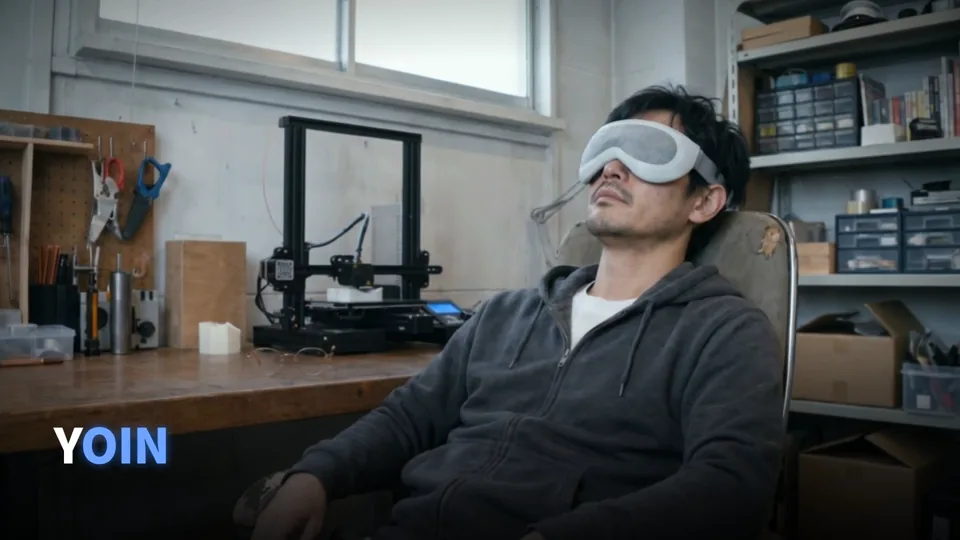
All the people in FablessBridge's published in-house samples are fictional people created with image generation AI, and the case pages say so. For example, for the smart eye mask "Yoine," we generated three candidates each for the CEO and the nurse and chose from them.
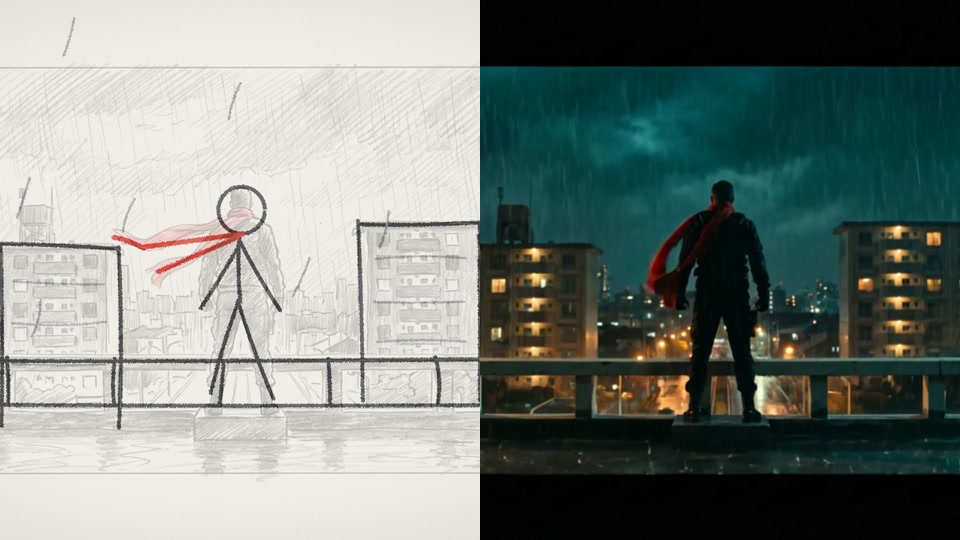
For "Notebook Doodles Become a Movie," we reviewed the 25 generated images before animating them, and regenerated the two where the hero's face was visible so that it sank into shadow. In the same review, we removed the emblem of a real car maker that had appeared on a car, and redrew a monster that resembled an existing one into an original design. Generative AI sometimes draws real-world shapes you did not ask for, so we check at the still-image stage before making video.
In client work as well, the finished video contains AI-generated material, so we ask the client's legal team to review it before publication.
What to check before commissioning a video
- 01Whether the video will feature real people (employees, models, celebrities) or be made with fictional people
- 02If it features real people, whether you have their written permission, covering their voice as well as their face
- 03Whether it contains faces or voices that resemble a celebrity, or names or costumes that suggest one
- 04Whether the terms of the AI service you use allow you to input material of real people
- 05If it will be used in ads, whether it complies with the policies of the platforms running them
Talk to us about your video
You don’t need a finished plan to get in touch.
ContactSee pricing and the production process