
Finished video
Hiroshige ukiyo-e print turned into a 3D brand film
A 30-second portrait video, made as an attempt to animate Japanese art with today's technology, that splits one Hiroshige print into layers, rebuilds it in space and enters a street of Edo cotton wholesalers
Narration and on-screen text are in Japanese. The sections below describe the video in English.
How it was made: One ukiyo-e print was cut into layers for the women, the row of shops, the ground, the distant view, the pillar and the title cartouche. Wall areas hidden in the picture were filled in by copying the repeating shopfronts in matching perspective. The layers were placed in space in 3D software (Blender), with every operation done by script. Music and sound effects were made with generative AI (ElevenLabs) and finished in editing (no filming or narration)
A video like this$700 (excl. tax) · As few as 5 business days30 seconds, portrait | Pricing
Overview and production conditions
- We were looking for something distinctive to Shian for our Instagram posts.
- Thinking of traditional Japanese aesthetics as a strength of Japan led to the idea of animating ukiyo-e.
- One Hiroshige print is split into layers, made 3D, and the camera walks into the street in the picture.
- Where it runs
- A 30-second portrait 9:16 video planned for Instagram. The last scene returns to the opening image, so it connects when played on loop
- Structure
- It starts as the original print, splits into layers that move apart, assembles into a street with depth, walks through the street, then pulls back quickly to the opening image
- Approach
- From the front it always looks like the original single picture, and from the side the layers appear separated. Every layer moves only along lines that project to the same position from the original viewpoint. There is no narration or text, and the video is carried by koto, shamisen and taiko music and sound effects
- Production time
- From the first discussion around 7 p.m. on October 12, 2026 to exporting the 30-second version with sound around 8 a.m. on the 13th (including an overnight break)
The 30 seconds, scene by scene
0–2.5 s: It starts as the original ukiyo-e print and soon begins to push in. Only a koto plays softly.
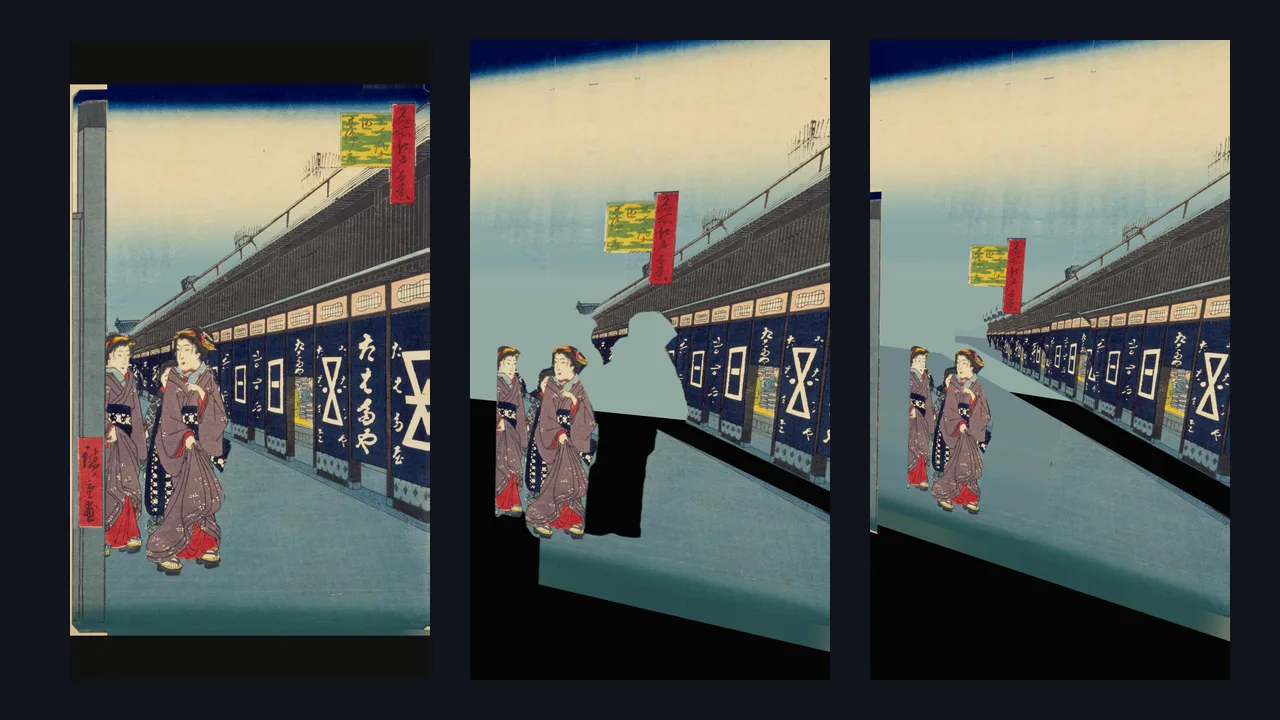
2.5–9.5 s: As the camera swings to the right, the picture splits into layers that move forward and back, with the sound of rustling washi paper. As the women step forward, women-shaped holes remain in the wall and ground, and they fill in as if painted over from above, in time with brush sounds.
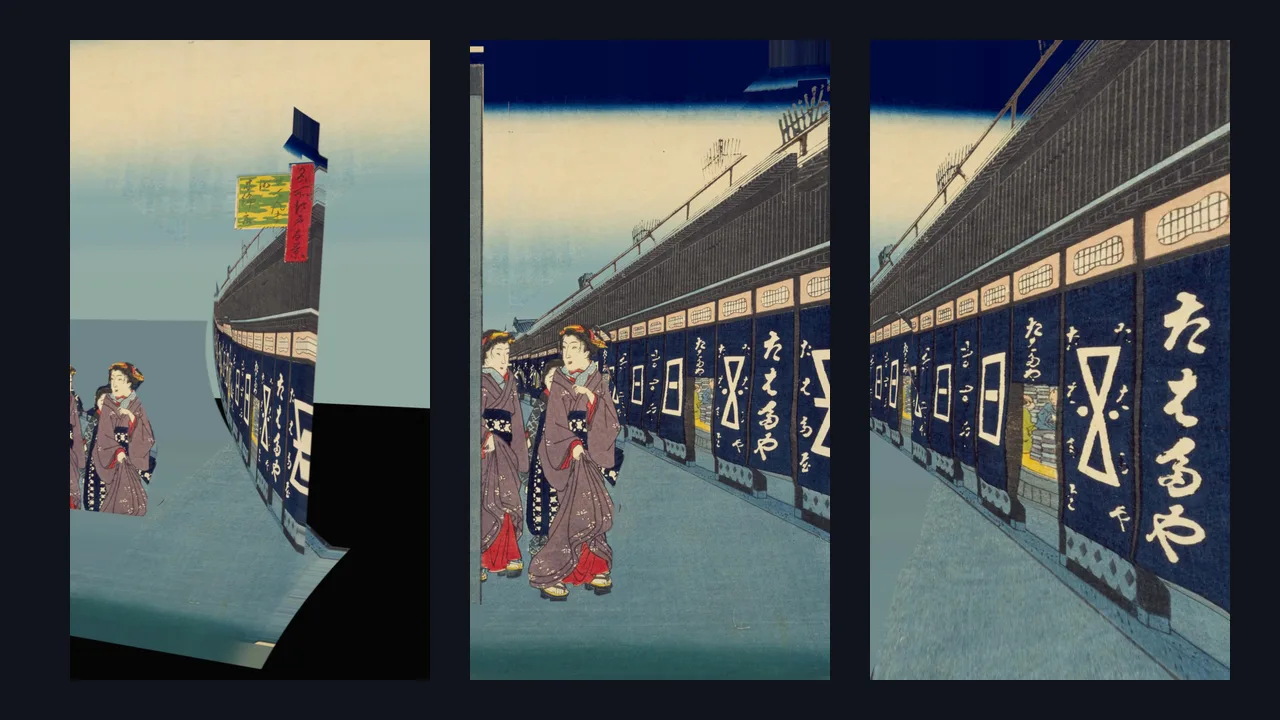
9.5–15 s: The layers bend like turning pages and assemble into a street with depth. Each time a layer snaps into place, wooden clappers sound, growing louder. The camera returns to the front, and for a moment it looks like the original picture again.
15–28 s: With a whoosh, the camera enters the street. It passes beside the women and walks in front of noren curtains swaying in the wind. The wind in the noren and distant geta footsteps continue.
28–30 s: A reversed whoosh pulls back quickly to the opening image.
Pilot vs. final cut
We first made two versions of a 10-second pilot and added motion. We then rebuilt it into a 30-second structure and added sound. The 9:16 footage is shown side by side with black bars on the left and right.
Full video
Swaying the noren and keeping the camera moving
- Aim
- Keep a visible change going until the end so it is clear that a still picture has come to life
- Instruction during production
- "Fix the points you want to fix. I agree, I want more movement."
- Adjustment
- The noren are fixed at the top pole and billow more toward the hem, with gusts traveling along the street. After passing the women, the camera turns toward the shops and keeps moving without stopping. In the second half the frame fills with noren and roofs, so the left side of the street, which the picture does not show, is no longer visible. We switched to the full-size image (2573×3915 px) and also sharpened the lettering on the nearest noren
Cutting the layers and the production process
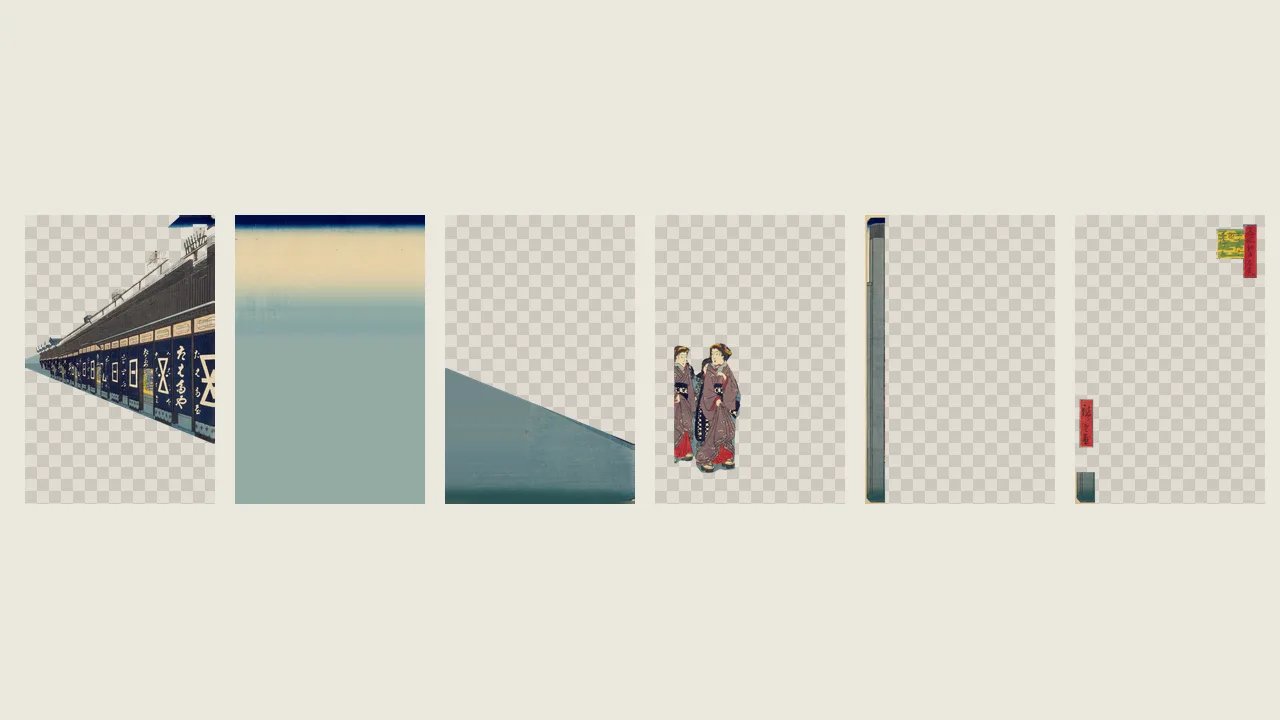
- Source image
- We chose one famous-places print from about 110 ukiyo-e reference images on hand. It is Utagawa Hiroshige's "One Hundred Famous Views of Edo: Cotton-Goods Lane, Ōdenma-chō", held by the National Diet Library and published on Wikimedia Commons as public domain
- Music
- We made two options with generative AI and used the modern Japanese one with koto, shamisen and taiko. The other was not used because its first 10 seconds were silent and it had almost no dynamics
- Sound effects
- Seven kinds were generated (rustling washi, brush, wooden clappers, two kinds of whoosh, wind in the noren, and footsteps in the street) and placed to match events in the footage
- 01Choose one famous-places print from the ukiyo-e candidates
- 02Cut the picture into layers and fill in the hidden walls
- 03Place the layers in space in Blender and make a 10-second pilot
- 04Add swaying noren and a camera that never stops
- 05Rebuild into a 30-second structure and add music and sound effects
More work


Talk to us about your video
You don’t need a finished plan to get in touch.
Ask about a video like thisSee pricing and the production process